
Air cooling vs liquid cooling is the comparison between a heatsink with a fan and a closed or custom liquid loop that moves CPU heat to a radiator. The two differ in thermal performance, noise, reliability, cost, clearance, and maintenance – and high-end air coolers such as the Noctua NH-D15 rival a 240 to 280 mm all-in-one liquid cooler, while larger 360 mm radiators lead at high heat loads.
What Is the Difference Between Air and Liquid Cooling?
Air and liquid cooling differ in whether heat travels through a metal heatsink into the air directly, or through a liquid coolant to a remote radiator first. Air rejects heat right at the socket; liquid moves it to a radiator mounted on the case.
Air cooling
Liquid cooling (AIO)
Both share the same conduction-then-convection heat-transfer chain, and both depend on a good thermal-paste layer.
How Does Air Cooling Work?
Air cooling works by conducting heat from the CPU into a heatsink and convecting it into moving air. A copper baseplate draws heat into copper heat pipes, spreads it across an aluminium fin stack, and a 120-140 mm fan pushes air through the fins.
- Few moving parts: just one or two fans, with no moving liquid.
- Scales with size: heatsink mass, fin area, heat-pipe count, and fan airflow – a dual-tower (e.g. NH-D15, six pipes, two fans) dissipates 220 W+.
How Does Liquid Cooling Work?
Liquid cooling works by circulating coolant that absorbs CPU heat and carries it to a radiator for release into the air. A pump and cold plate sit on the CPU; coolant flows through tubes to a radiator where fans blow the heat out, then the cooled coolant returns.
- AIO vs custom: an all-in-one ships sealed and pre-filled; a custom loop adds a reservoir and can cool the GPU too.
- Radiator size sets capacity: 240, 280, and 360 mm reject progressively more heat.
- The pump is the added moving part that air cooling lacks (see reliability below).
Which Cooling Method Has Better Thermal Performance?
On thermal performance, high-end air rivals a 240-280 mm AIO, while a 360 mm radiator leads at sustained high heat loads.
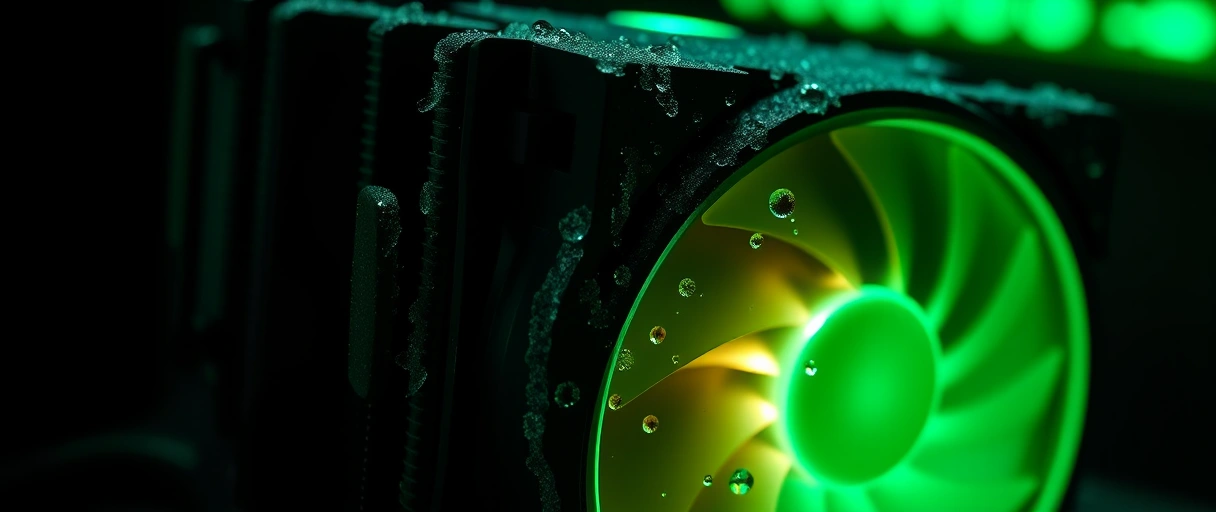
- Flagship air (NH-D15, Dark Rock Pro 5) matches or beats many 240 mm AIOs – the large fin stack handles 220 W+.
- 280-360 mm AIOs pull ahead on 250 W+ chips (Core i9, Ryzen 9 all-core), rejecting heat away from the socket.
- It is size, not method: a small 120 mm AIO often loses to a big air tower.
Which Cooling Method Is Quieter?
On noise, both can run quietly – air avoids pump noise, while liquid moves heat with smaller, faster radiator fans:
- Air: only fan noise – a big heatsink with low-RPM 140 mm fans runs under 25 decibels.
- Liquid: a constant pump hum on top of radiator-fan noise; a 360 mm radiator lets its fans spin slower than a 240 mm.
- Radiator fans need static pressure and run louder than open-air case fans at the same airflow.
Which Cooling Method Is More Reliable?
On reliability, air lasts longer because it has no pump and no liquid to fail:
- Air: the only moving parts are fans (50,000-150,000 hr bearings), and the heatsink never wears out – it often outlasts the build.
- Liquid: the pump is the most failure-prone part, and a sealed AIO cannot be refilled (pump wear or coolant evaporation ends it in 3-6 years).
- Failure mode: an AIO pump failure causes a fast thermal shutdown; an air cooler with a dead fan still cools passively at a reduced rate.
A quality AIO from Corsair, Arctic, or NZXT carries a 5-6 year warranty that offsets the added failure points.



How Do Cost and Clearance Compare?
On cost and clearance, air costs less and needs vertical height, while liquid costs more and needs radiator space:
- Cost: air 30-110 $, a 240-360 mm AIO 50-200 $, and a custom loop 300 $+.
- Air clearance: a tall tower (NH-D15 = 165 mm) can block tall RAM – check the case height limit and RAM clearance.
- Liquid clearance: the radiator needs 240/280/360 mm mounting space in the top or front, leaving the area above the socket open for tall memory.
| Dimension | Air Cooling (Heatsink + Fan) | Liquid Cooling (AIO / Custom) |
|---|---|---|
| Thermal performance | Rivals 240 to 280 mm AIO at high end | Leads at 280 to 360 mm under heavy load |
| Noise | Fan noise only, no pump | Fan noise plus pump hum |
| Reliability | No pump, fans last 50,000 hrs+ | Pump can fail, sealed AIO not refillable |
| Cost | 30 to 110 dollars | 50 to 200 dollars (AIO), 300+ (custom) |
| Clearance need | Tower height, may block RAM | Radiator mounting space in case |
| Maintenance | Occasional dusting | AIO maintenance-free, custom needs top-ups |
| Lifespan | 10+ years typical | 3 to 6 years for a sealed AIO |
Which Cooling Method Suits Which CPU and Build?
The right method depends on the CPU heat output, the case, and whether it is overclocked:

- Mainstream (i5 / Ryzen 5, 65-125 W): a mid-size air cooler under 50 $ runs cool.
- High-core-count (i9 / Ryzen 9, 200 W+): a large air tower or a 280-360 mm AIO avoids throttling.
- Overclocked: a 360 mm AIO or custom loop for the extra radiator capacity.
- Small-form-factor: a low-profile air cooler or a 240 mm AIO where a full tower will not fit.
Last Thoughts on Air Cooling vs Liquid Cooling
Air cooling vs liquid cooling is a trade between simplicity and peak thermal headroom rather than a strict ranking. Air cooling moves heat through a heatsink into the air with no pump, costs less, and lasts longer, which suits mainstream and mid-range processors. Liquid cooling carries heat to a radiator with 280 to 360 mm sizes leading on high-core-count and overclocked CPUs, at higher cost and a finite pump lifespan.
A builder matches the method to the processor heat output, the case clearance, and the noise target. Readers can continue with the explanation of how CPU coolers work, the AIO versus custom loop comparison, or the guide to lowering CPU temperature, and the computer hardware guide places cooling within the full build.
Key Takeaways:
- Air cooling moves heat through a heatsink into the air, while liquid cooling carries heat through coolant to a remote radiator.
- High-end air rivals a 240 to 280 mm AIO, while 360 mm radiators lead on processors that sustain 250 watts or more.
- Air cooling is more reliable because it has no pump, while a sealed AIO can fail through pump wear in 3 to 6 years.
- Air cooling costs 30 to 110 dollars, while a 240 to 360 mm AIO costs 50 to 200 dollars and a custom loop exceeds 300.
- Air coolers need tower height and may block RAM, while liquid coolers need radiator mounting space in the case.
Frequently Asked Questions (FAQs)
Is liquid cooling better than air cooling?
Liquid cooling leads on processors that sustain 250 watts or more with a 280 to 360 mm radiator. High-end air coolers rival 240 to 280 mm AIO units at lower cost and higher reliability.
Does liquid cooling cool better than air?
A 360 mm AIO cools high-heat CPUs better than most air coolers. A flagship air cooler such as the Noctua NH-D15 matches a 240 to 280 mm AIO in many independent tests.
Can air cooling handle an overclocked CPU?
Yes, for moderate overclocks. A large dual-tower air cooler dissipates over 220 watts. Heavy overclocks on a Core i9 or Ryzen 9 favor a 360 mm AIO or custom loop.
Do AIO liquid coolers leak?
Sealed AIO coolers rarely leak because the loop is pre-filled and closed at the factory. The more common failure is pump wear or coolant evaporation over 3 to 6 years.
Is air cooling more reliable than liquid cooling?
Yes. Air cooling has no pump and no liquid, so its only moving parts are fans rated for 50,000 hours or more. A sealed AIO adds a pump that can fail.
Which is cheaper, air or liquid cooling?
Air cooling is cheaper, costing 30 to 110 dollars. A 240 to 360 mm AIO costs 50 to 200 dollars, and a custom liquid loop exceeds 300 dollars.
About the author

Nizam Ud DeenFounder and Tech Blogger
Muhammad Nizam Ud Deen Usman is the founder of theCoreiTech and the author of The Local SEO Cosmos. He has worked in search since 2014 as an SEO consultant for eCommerce stores and local businesses, specialising in eCommerce SEO, local SEO and technical SEO, and runs SEO Academy and the SEO Community from Multan, Pakistan. He also founded ORM Digital Solutions, a digital agency serving medium and large businesses, and holds a degree from the University of Education, Lahore (Multan Campus). Plerdy lists him among its Best 20+ SEO Experts in Pakistan. Nizam started theCoreiTech in 2012 to make computers easier to understand and use for everyone. More of his work is at nizamuddeen.com.
