
Nvidia vs AMD is the comparison between the two companies that design the graphics processors in most gaming and workstation graphics cards. Nvidia builds the GeForce RTX line, now the RTX 50 series on the Blackwell architecture, and AMD builds the Radeon RX line, now the RX 9000 series on the RDNA 4 architecture, with Intel Arc as a third entrant. The brands differ in raster performance per tier, ray-tracing strength, upscaling technology, video memory, power efficiency, software ecosystem, and price-to-performance.
What Are Nvidia and AMD GPUs?
Nvidia and AMD GPUs are the graphics processors that power the two leading consumer graphics-card brands:
- Nvidia GeForce RTX: currently the RTX 50 series (5090, 5080, 5070 Ti, 5070, 5060) on the Blackwell architecture, the larger market share, and the lead in ray tracing and AI features.
- AMD Radeon RX: currently the RX 9000 series (9070 XT, 9070, 9060 XT) on RDNA 4, competing on raster performance per dollar and video memory capacity.
- Both drive games, video editing, and parallel GPU compute workloads, and both implement the same DirectX, Vulkan, and OpenGL APIs. Intel Arc is a third, budget-tier option.
Best for: read on for the per-dimension differences that decide the choice; the broader process of choosing a graphics card weighs them together.
Which Brand Has Better Raster Performance?
On raster performance, Nvidia and AMD trade leads tier by tier, and AMD usually delivers more raster frames per dollar. Rasterization is the traditional triangle-drawing method without ray tracing, and it sets frame rates in most games:
- Mid/high tier is near parity: the RX 9070 XT and RTX 5070 Ti land within roughly 6% of each other at 4K, trading wins by title.
- AMD wins the tier below: the RX 9070 XT beats the RTX 5070 (non-Ti) by about 14 to 31% at 4K, and the RX 9070 roughly matches or edges the RTX 5070.
- Nvidia keeps the crown: the RTX 5090, and the RTX 5080 above the 9070 XT, hold the absolute top. Raster scales with shader count, clock, and the underlying GPU architecture.
Which Brand Is Better for Ray Tracing?
For ray tracing, Nvidia holds a clear lead in heavy scenes. Ray tracing simulates light paths for accurate reflections, shadows, and global illumination on dedicated cores:
- Nvidia leads heavy RT: the RTX 5070 Ti runs up to about 78% faster than the RX 9070 XT in path-traced titles like Black Myth: Wukong, and roughly 24% faster in Dying Light 2.
- Light RT is close: in lighter ray-traced loads such as Resident Evil 4 and Dragon’s Dogma 2 the cards sit near parity.
- AMD closed ground: RDNA 4 made large ray-tracing gains over RDNA 3, but still drops more frames in the hardest ray-traced lighting.
Best for: heavy ray-tracing and path-tracing titles at high settings favor Nvidia RTX 50; rasterized esports buyers see little benefit from the gap.
How Do DLSS 4, FSR 4, and XeSS Upscaling Compare?
DLSS 4, FSR 4, and XeSS are upscalers that render at a lower resolution and reconstruct a higher-resolution image to raise frame rates. The differences:
DLSS 4 (Nvidia)
FSR 4 (AMD)
XeSS (Intel)
DLSS is Nvidia-only, so an RX 9070 XT cannot run it and uses FSR or XeSS instead. Upscaler quality often matters more than raw raster at 4K, a factor the video memory requirement at 4K also influences. Best for: Nvidia wins the upscaling edge in titles that support DLSS 4; FSR 4 narrows it enough that AMD stays competitive.
How Does VRAM Allocation Compare Per Tier?
On video memory, AMD generally allocates more VRAM than Nvidia at the same price tier. Capacity sets the resolution and texture detail a card sustains before performance drops:




- Mid tier favors AMD: the RX 9070 XT and RX 9070 ship 16 GB of GDDR6, while the similarly priced RTX 5070 ships 12 GB of GDDR7.
- Higher tiers match: the RTX 5070 Ti and RTX 5080 also carry 16 GB, and the RTX 5090 carries 32 GB of GDDR7.
- Why it matters: 12 GB increasingly limits 4K and high-texture 1440p, as the guide to how much VRAM is needed explains. Nvidia softens the gap with memory compression and DLSS rendering at a lower internal resolution.
Best for: buyers keeping a card several years or running 4K texture packs gain from AMD’s 16 GB at the mid tier; heavy DLSS users tolerate the RTX 5070’s 12 GB.
How Do Power Efficiency and Drivers Compare?
On power and software, Nvidia leads efficiency and ecosystem breadth, while AMD has narrowed the gap:
- Efficiency: Blackwell keeps a perf-per-watt edge; the RX 9070 XT draws around 304W TDP (about 310W in games), and reviewers note Nvidia stays advantaged on efficiency.
- Nvidia ecosystem: the widely adopted CUDA platform dominates GPU compute and AI, plus the NVENC encoder, DLSS 4, and Reflex.
- AMD ecosystem: the open ROCm compute stack, FSR 4, the AMF encoder, and competitive RDNA 4 raster efficiency. Driver stability has improved on both sides with regular game-ready updates.
Best for: creators on CUDA-accelerated apps such as Blender OptiX favor Nvidia; rasterized gamers on open standards find AMD competitive. Higher draw on either brand raises the cooling requirement of the graphics card.
Which Brand Offers Better Value?
On value, AMD leads raster performance per dollar, while Nvidia leads feature-adjusted value:
- Raster per dollar: the RX 9070 XT delivers near-RTX 5070 Ti raster for $150 less MSRP, and AMD held closer to list price through the 2026 supply crunch.
- Feature-adjusted: buyers who weigh ray tracing, DLSS 4, NVENC, and CUDA often find the Nvidia premium worth it.
- Street prices move: both brands sold above MSRP in 2026, so a buyer compares the exact cards in a budget on the day.
Nvidia vs AMD GPU Comparison Table
The table compares the brands across the primary buying dimensions, using the current RTX 50 and RX 9000 generations:
| Dimension | Nvidia (GeForce RTX 50) | AMD (Radeon RX 9000) |
|---|---|---|
| Raster per dollar | Competitive, higher cost (RTX 5070 Ti $749) | Frequently leads (RX 9070 XT $599) |
| Ray tracing | Clear lead, up to ~78% in heavy RT | Large RDNA 4 gains, still trails in heavy RT |
| Upscaling | DLSS 4 + Multi Frame Generation (RTX 50) | FSR 4, now AI-based, close in standard games |
| VRAM (mid tier) | RTX 5070 = 12 GB | RX 9070 / 9070 XT = 16 GB |
| Compute ecosystem | CUDA, dominant in AI | ROCm, open but smaller |
| Video encoding | NVENC, leading quality | AMF, competitive |
| Power efficiency | Advantaged on Blackwell | RX 9070 XT ~304W, competitive |
Which Brand Is Better for Content Creation?
For content creation, Nvidia leads because CUDA accelerates most creative applications:
- Render and export: Premiere Pro, DaVinci Resolve, and Blender accelerate through CUDA and NVENC; Blender Cycles uses OptiX to ray-trace on RT cores, finishing faster than AMD’s HIP path.
- Encoding: NVENC produces higher-quality output at a given bitrate for streaming and export.
- AMD strengths: Radeon cards handle raster preview and timeline playback well and benefit from large video memory pools for high-resolution timelines, but narrower acceleration support places AMD behind for export-heavy work.
Best for: frequent 3D rendering or video export favors Nvidia; budget editing at lower resolutions finds AMD’s raster value sufficient. 4K and 8K timelines and large 3D scenes consume more VRAM than gaming at the same resolution.
How Do Cooling and Card Size Compare?
On cooling and size, both brands ship cards across a wide size range, with the cooler scaled to the power draw:
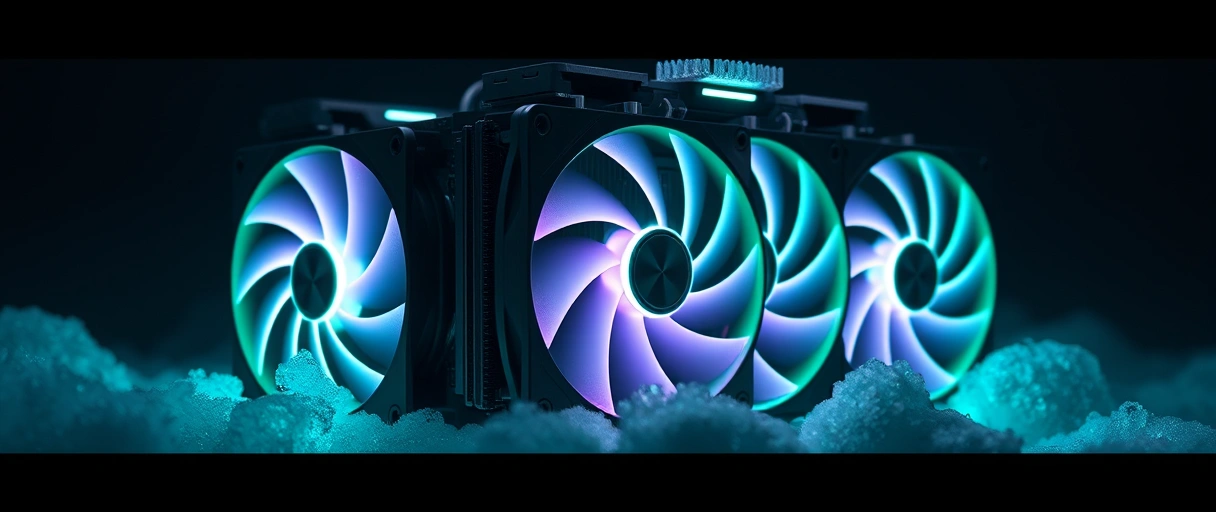
- Higher power, bigger cooler: flagship RTX 50 and RX 9000 cards occupy three or more slots and exceed 300 mm; the RTX 5090 in particular draws heavily and runs large triple-fan coolers.
- Partner models vary: ASUS, MSI, Gigabyte, and Sapphire build custom coolers on both brands, so thermals depend on the model, not the brand.
- Fit and power first: a buyer confirms card length and slot count fit a compact case, and the draw that sizes the cooler also sets the power-supply requirement and the cooling design of the card.
Last Thoughts on Nvidia vs AMD GPUs
Nvidia vs AMD has no single winner because each brand leads a defined dimension. On the current generations, Nvidia’s RTX 50 (Blackwell) leads ray tracing, DLSS 4 image quality, efficiency, and the CUDA compute ecosystem, while AMD’s RX 9000 (RDNA 4) leads rasterized performance per dollar and ships 16 GB at the mid tier.
A heavy ray-tracing and 4K buyer favors Nvidia GeForce, a value raster buyer at 1080p or 1440p favors AMD Radeon, and a creator who depends on CUDA favors Nvidia. Readers can continue with the graphics card selection guide, the video memory requirement by resolution, or the explanation of ray tracing to finalize a model, and the list of gaming graphics cards narrows the choice within either brand.
Key Takeaways:
- Raster is near parity at the mid tier, the RX 9070 XT within about 6% of the RTX 5070 Ti, and AMD delivers more rasterized frames per dollar.
- Nvidia leads ray tracing, up to roughly 78% faster than the RX 9070 XT in heavy path-traced scenes on the RTX 50 series.
- DLSS 4 leads, FSR 4 closes in, DLSS 4 adds Multi Frame Generation on RTX 50, while AI-based FSR 4 is close in standard games but trails in heavy RT and game support. DLSS is Nvidia-only.
- AMD ships more VRAM mid tier, 16 GB on the RX 9070 XT and RX 9070 versus 12 GB on the RTX 5070.
- Nvidia leads compute and efficiency with CUDA, NVENC, and Blackwell perf-per-watt, while AMD competes on raster value and open standards.
Frequently Asked Questions (FAQs)
Is Nvidia or AMD better for gaming in 2026?
It splits by need. AMD’s RX 9070 XT and RX 9070 win rasterized frames per dollar and ship 16 GB, while Nvidia’s RTX 50 series leads ray tracing, DLSS 4 image quality, and efficiency. Pick AMD for raster value, Nvidia for heavy ray tracing.
Does AMD have something like DLSS 4?
Yes. AMD FSR 4 is its upscaler, and on RDNA 4 it is now AI-based, landing close to DLSS 4 in standard gaming. The gap is heavy ray tracing and game support, where DLSS 4 still leads. DLSS itself runs only on Nvidia RTX cards.
Do AMD cards have more VRAM than Nvidia?
Often at the mid tier. The RX 9070 XT and RX 9070 carry 16 GB, while the RTX 5070 ships 12 GB at a similar price. Higher Nvidia cards (RTX 5070 Ti, 5080) match at 16 GB, and the RTX 5090 carries 32 GB.
Is Nvidia better for ray tracing?
Yes. The RTX 50 series keeps a clear lead in heavy ray tracing, running up to about 78% faster than the RX 9070 XT in path-traced titles like Black Myth: Wukong. RDNA 4 closed the gap in light ray tracing but still trails in the hardest scenes.
Which brand is better for video editing and AI?
Nvidia, because CUDA, OptiX, and the NVENC encoder are the widest-supported path in Premiere Pro, DaVinci Resolve, and Blender. AMD uses the open ROCm stack and AMF encoder, which work but have narrower application support.
Is AMD cheaper than Nvidia in 2026?
Usually per frame. The RX 9070 XT launched at $599 against the RTX 5070 Ti at $749 for similar raster, and AMD held closer to MSRP through 2026. Nvidia commands a premium for ray tracing, DLSS 4, and CUDA.
About the author

Nizam Ud DeenFounder and Tech Blogger
Muhammad Nizam Ud Deen Usman is the founder of theCoreiTech and the author of The Local SEO Cosmos. He has worked in search since 2014 as an SEO consultant for eCommerce stores and local businesses, specialising in eCommerce SEO, local SEO and technical SEO, and runs SEO Academy and the SEO Community from Multan, Pakistan. He also founded ORM Digital Solutions, a digital agency serving medium and large businesses, and holds a degree from the University of Education, Lahore (Multan Campus). Plerdy lists him among its Best 20+ SEO Experts in Pakistan. Nizam started theCoreiTech in 2012 to make computers easier to understand and use for everyone. More of his work is at nizamuddeen.com.
