
Biometric authentication is the process of verifying identity using a unique physical or behavioral trait, such as a fingerprint, a face, an iris, or a voice, instead of a secret you have to remember. It is the “something you are” factor of authentication. The system measures a trait once, converts it into a mathematical template, and at each login compares a fresh scan against that stored template within a set tolerance. The defining trade-off is that a biometric is convenient and hard to share, but unlike a password it cannot be reset if it is ever exposed.
What Is Biometric Authentication?
Biometric authentication proves you are who you claim to be using a trait that belongs to your body or your behavior, not a secret in your head. It is one of the three factors of identity: something you know (a password), something you have (a key or phone), and something you are (a biometric). The National Institute of Standards and Technology (NIST) calls this the inherence factor in Special Publication 800-63. Because the trait is part of you, there is nothing to type, forget, or write down.
A biometric is the inherence factor described in authentication. On its own it usually unlocks a device rather than logging you into a remote service, and pairing it with a second factor is part of multi-factor authentication.
What Are the Main Types of Biometric Authentication?
The four common modalities are fingerprint, face, iris, and voice, and they differ sharply in accuracy and in how easily they can be faked.
Beyond these four, behavioral biometrics measure how you act rather than a fixed trait, such as typing rhythm, gait, or how you hold a phone. They usually run quietly in the background as a continuous signal rather than a single login check.
How Does Biometric Authentication Work?
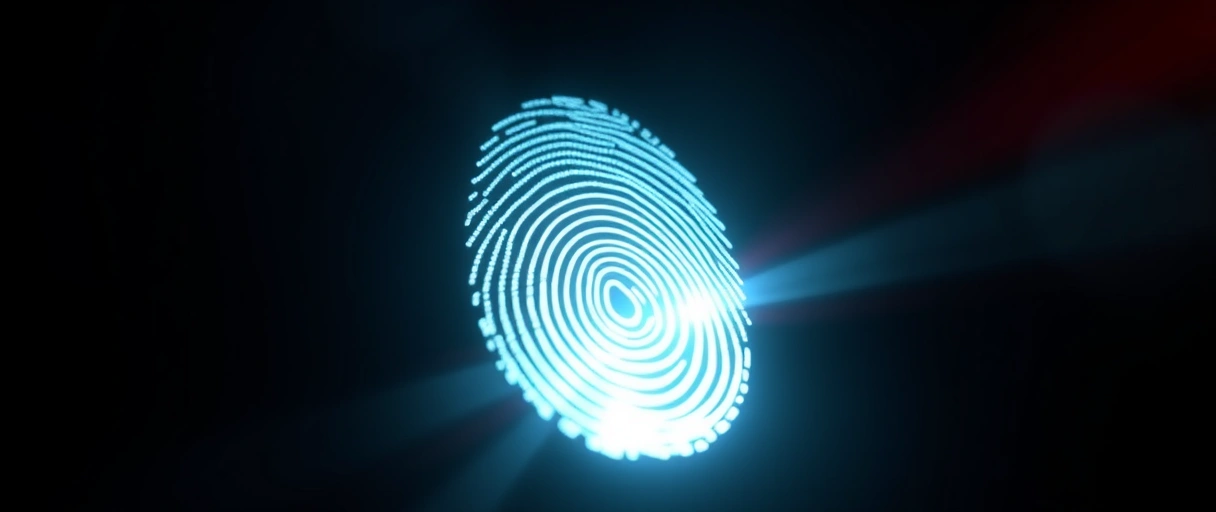
Every system follows the same shape: enroll the trait once, then match a fresh scan against the stored template at each login.
- Capture. A sensor reads the trait, such as a fingerprint reader, a camera, or a microphone.
- Extract a template. Software turns the reading into a mathematical template, a set of feature points. It is not a stored photo, and it cannot be reversed back into your fingerprint or face.
- Store securely. The template is saved in isolated hardware on the device, such as a Secure Enclave or a TPM, not on a central server.
- Compare. At login a new scan is matched against the stored template. A biometric is fuzzy, so the system accepts any scan that falls within a set tolerance and releases only a yes-or-no result.
Because the match is a similarity score rather than an exact equality check, the tolerance threshold is a deliberate dial. Tighten it and impostors are rejected more often but so are legitimate users; loosen it and the reverse happens. A successful match typically does not send your trait anywhere; it unlocks a device-bound key that signs you in, the same design behind passkeys.
Where Is Biometric Data Stored?
On modern devices the template is stored locally in protected hardware and never sent to the vendor, which is the single most important fact about biometric privacy.
- On-device, in isolated hardware: Apple holds the template in the Secure Enclave and Windows Hello keeps it in an encrypted store tied to the TPM. The data cannot be exported and is not sent to Apple or Microsoft.
- A template, not an image: what is saved is a mathematical representation that cannot be turned back into your original trait.
- Matching happens locally: the comparison runs inside the protected hardware, which releases only a match result, so an app never sees the raw trait.
- No central honeypot: because there is usually no server-side database of templates, there is no single store for an attacker to breach.
This on-device model is what makes consumer biometrics safe to use, and it is why losing your phone does not hand over your fingerprint. The picture changes when an organization runs server-side biometrics, for example a bank matching your voice in the cloud, because that does create a central store and brings the privacy duties in the next section.


What Are the Advantages and Disadvantages?
A biometric is convenient and hard to share, but it is permanent and imperfect, and both sides matter.
- Advantage, convenience: nothing to remember or type, and a scan completes in well under a second.
- Advantage, hard to share or phish: a trait cannot be emailed to an attacker or read off a sticky note the way a password can.
- Advantage, tied to one person: it links an action to the actual user, not just to whoever knows the secret.
- Disadvantage, no reset: a leaked or copied trait is permanent, so it cannot be reissued like a password.
- Disadvantage, it can be spoofed: a copied fingerprint, a mask, or a deepfake can fool a sensor that lacks liveness detection.
- Disadvantage, it is not exact: matching produces a false acceptance rate (wrong person let in) and a false rejection rate (right person locked out), and accuracy varies with capture quality.
How Are Biometrics Spoofed, and What Is Liveness Detection?
There are two distinct attacks, and the deepfake era of 2025 and 2026 has made the second one the harder problem.
- Presentation attack: the attacker holds a fake in front of the sensor, such as a printed photo, a silicone mask, a lifted fingerprint, or a replayed video. Liveness detection, also called presentation attack detection (PAD), defends against this by checking that a real, live person is present. The ISO/IEC 30107-3 standard sets the test levels for it.
- Injection attack: the attacker skips the camera entirely and feeds a synthetic or deepfake video straight into the software through a virtual camera. PAD that only watches the lens can miss it, which is why injection attacks have surged as deepfake and virtual-camera tools became easy to obtain.
The practical takeaway is that liveness detection is now mandatory for any remote biometric check, and the strongest systems test for both presentation and injection attacks. Voice is the most exposed modality here, since a convincing clone can be generated from roughly 30 seconds of audio, which is why voice alone is a poor guard for high-value actions.
How Is Biometric Accuracy Measured?
Three numbers describe how reliable a biometric system is, and they always trade against each other.
- False acceptance rate (FAR): how often the system lets in the wrong person. Lower is more secure.
- False rejection rate (FRR): how often it rejects the right person. Lower is more convenient.
- Equal error rate (EER): the point where FAR and FRR are equal, used to compare systems on one number.
You cannot drive both error rates to zero at once; tightening the threshold lowers false accepts but raises false rejects, so each system picks a balance for its use. Accuracy also depends heavily on capture quality and conditions. In NIST face-recognition testing the leading 1:N system reached an error near 0.07 percent, but real-world results fall when lighting is poor or a camera is badly angled, an effect NIST notes can hit some groups harder than others.
Is Biometric Data Protected by Privacy Law?
Yes, biometrics are treated as especially sensitive data, and the rules are stricter than for ordinary personal data.
- EU and UK GDPR: a biometric used to identify a person is special category data under Article 9. Processing it needs both a lawful basis under Article 6 and a separate Article 9 condition, most often explicit consent.
- Illinois BIPA: the leading US state law requires informed consent before collection and sets rules for storage and disclosure. A 2024 amendment, held to apply retroactively by the Seventh Circuit in April 2026, counts repeated same-method scans of one person as a single violation rather than one per scan.
- Why it is regulated this way: because a biometric is permanent and cannot be reissued, lawmakers hold it to a higher bar than data a person can change.
The on-device storage model also reduces legal exposure, because keeping templates on the user’s hardware avoids building the central database that privacy law scrutinizes most. The wider topic sits under data privacy.
What Are the Common Biometric Systems?
The biometrics most people use every day are built into their phones and laptops and follow the on-device model described above.

- Apple Face ID: maps a face with a depth-sensing camera, stores the template in the Secure Enclave, and resists a flat photo.
- Apple Touch ID: reads a fingerprint and, like Face ID, keeps the template in the Secure Enclave to unlock the device and authorize actions.
- Windows Hello: signs you into Windows with a face or fingerprint, holding the data in an encrypted store tied to the TPM that is never sent to Microsoft.
- Android biometrics: a fingerprint or face checked through the platform BiometricPrompt framework, backed by the device’s secure hardware.
In every case the biometric is a local gesture that unlocks a device-bound key rather than something sent over the network. That is exactly how a fingerprint or face comes to release a passkey for passwordless sign-in, and why these systems slot in as the inherence factor inside multi-factor authentication.
Last Thoughts on Biometric Authentication
Biometric authentication is the “something you are” factor: it proves identity with a fingerprint, face, iris, or voice by matching a fresh scan against a stored template. The design that makes it safe is on-device storage in isolated hardware, where the template is never a raw image, never leaves the device, and only ever releases a yes-or-no result that unlocks a device-bound key. Fingerprint is the most deployed modality and iris the most accurate, while voice is the most exposed to deepfake cloning.
The defining limit is permanence: a biometric cannot be reset like a password, which is why liveness detection, on-device storage, privacy law, and pairing with a second factor all exist to contain the cost of a leak. Biometrics are one piece of identity, not the whole of it, and the hub on cybersecurity connects them to the wider set of defenses.
Key Takeaways:
- Biometric authentication is the inherence factor: it verifies identity with a physical or behavioral trait instead of a remembered secret.
- Systems store a mathematical template, never a raw image, and that template cannot be reversed back into your trait.
- On modern devices the template stays in isolated hardware such as a Secure Enclave or TPM and is never sent to the vendor.
- A leaked biometric cannot be reset like a password, so it is best used as a local unlock and paired with a second factor.
- Spoofing comes as presentation attacks and as deepfake injection attacks, and liveness detection is built to stop them.
- Biometrics used to identify a person are regulated as sensitive data under GDPR Article 9 and Illinois BIPA.
Frequently Asked Questions (FAQs)
What is biometric authentication in simple terms?
Biometric authentication verifies who you are using a physical or behavioral trait, such as a fingerprint, a face, or an iris pattern. It is the “something you are” factor, so you prove identity with a part of yourself instead of a password you have to remember.
Is biometric data stored as a picture of my fingerprint or face?
No. The sensor converts the trait into a mathematical template, and that template cannot be reversed back into your original image. On Apple and Windows devices the template is held in isolated hardware such as the Secure Enclave or TPM, never sent to the vendor, and never stored as a raw image.
Can biometric authentication be hacked or spoofed?
Yes, two ways. A presentation attack holds a fake in front of the sensor, such as a printed photo, a mask, or a replayed video, and liveness detection is built to catch it. An injection attack bypasses the camera and feeds a synthetic or deepfake stream straight into the software, and this is the faster-growing threat through 2025 and 2026.
What happens if my fingerprint or face data is leaked?
You cannot reset a biometric the way you reset a password. A trait is permanent, so a genuine leak is a lasting problem, which is why systems keep the template on the device and pair the biometric with another factor. On-device storage means there is usually no central database to leak in the first place.
Is biometric data protected by privacy law?
Yes. Under the EU and UK GDPR, biometrics used to identify a person are special category data and need both a lawful basis and an Article 9 condition such as explicit consent. In the United States, Illinois BIPA governs collection and consent, though a 2024 amendment, held retroactive by the Seventh Circuit in April 2026, treats repeated same-method scans as a single violation.
What is the difference between Touch ID and Face ID?
Touch ID reads a fingerprint through a sensor, while Face ID maps a face with a depth-sensing camera that resists photos. Both store the template in the Secure Enclave and use it to unlock a device-bound key, so the biometric never leaves the device and only a yes-or-no result is released.
About the author

Nizam Ud DeenFounder and Tech Blogger
Muhammad Nizam Ud Deen Usman is the founder of theCoreiTech and the author of The Local SEO Cosmos. He has worked in search since 2014 as an SEO consultant for eCommerce stores and local businesses, specialising in eCommerce SEO, local SEO and technical SEO, and runs SEO Academy and the SEO Community from Multan, Pakistan. He also founded ORM Digital Solutions, a digital agency serving medium and large businesses, and holds a degree from the University of Education, Lahore (Multan Campus). Plerdy lists him among its Best 20+ SEO Experts in Pakistan. Nizam started theCoreiTech in 2012 to make computers easier to understand and use for everyone. More of his work is at nizamuddeen.com.
