
Ray tracing is a rendering technique that simulates the paths of individual light rays to produce physically accurate reflections, shadows, and lighting. Instead of approximating light the way rasterization does, it traces rays from the camera into the scene, follows how they bounce off surfaces, and calculates illumination from the geometry of light itself – which is why a wet street reflects the right neon sign and a colored wall bleeds its hue onto the floor.
What Is Ray Tracing?
Ray tracing is a rendering technique that simulates the travel of light rays through a scene to calculate reflections, shadows, and global illumination with physical accuracy:
- It casts rays from the virtual camera into the 3D scene and finds which surface each ray strikes (the ray-object intersection).
- It spawns secondary rays from that hit point toward light sources and reflective surfaces to compute color, brightness, and shadow.
- It models light physically, so it reproduces reflections, soft shadows, and indirect lighting that older methods approximate or omit.
- It runs in real time only with dedicated GPU hardware; the graphics-card rendering pipeline is where this technique sits.
Ray tracing existed for decades in offline film rendering, where a single frame could take hours. NVIDIA brought it to consumer games with its RTX cards, and AMD and Intel followed. Best for: understanding why modern game lighting looks grounded rather than painted on.
How Is a Ray Traced? (Step by Step)
A frame is ray traced by following each ray from the camera, testing it against an acceleration structure, and bouncing it to gather light:
- Cast. A primary ray is shot from the camera through each pixel into the scene.
- Traverse the BVH. The ray is tested against a bounding volume hierarchy (BVH) – nested boxes – so it checks only relevant geometry instead of every triangle.
- Find the hit. The closest surface the ray intersects is identified, along with its material and angle.
- Spawn secondary rays. Shadow rays go to each light (is the point lit or occluded?); reflection and refraction rays bounce onward.
- Bounce and accumulate. Those rays repeat the process, gathering indirect light over one or more bounces (many bounces = path tracing).
- Shade the pixel. The gathered light is combined into the final pixel color, then a denoiser cleans up under-sampled noise.
How Does Ray Tracing Differ From Rasterization?
Ray tracing differs from rasterization because rasterization projects geometry onto the screen and approximates lighting, while ray tracing simulates the actual paths of light rays:
- Rasterization: converts triangles to pixels and fakes lighting with shadow maps and screen-space reflections – fast, but it cannot show light or objects that are off-screen.
- Ray tracing: follows rays from the camera and computes how light reaches each point from its true source, including reflections of objects the camera cannot see.
- Speed gap: rasterization is far faster and remains the real-time baseline, so games run a hybrid – raster draws the base image, ray tracing adds reflections, shadows, or global illumination on top.
Pure ray tracing of an entire scene is still more demanding than most hardware sustains at high frame rates, which is why the hybrid model dominates. Best for: seeing why ray tracing is added selectively rather than replacing rasterization outright.
What Does Ray Tracing Improve in Games?
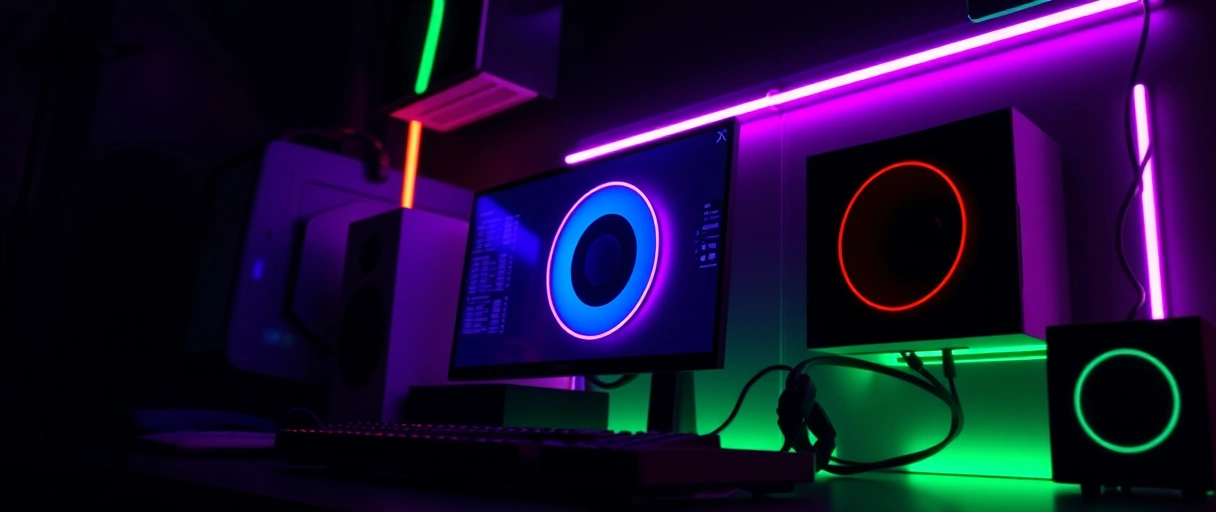
Ray tracing improves the lighting effects rasterization approximates poorly:
Reflections
Shadows
Global illumination
Ambient occlusion
These effects respond correctly to scene geometry and off-screen elements, and the gain is biggest in scenes with reflective surfaces, complex lighting, and large environments. Best for: reflective, light-heavy, or large indoor and outdoor scenes – where the cost is also highest, which is why upscaling is paired with it.
What Hardware Accelerates Ray Tracing?
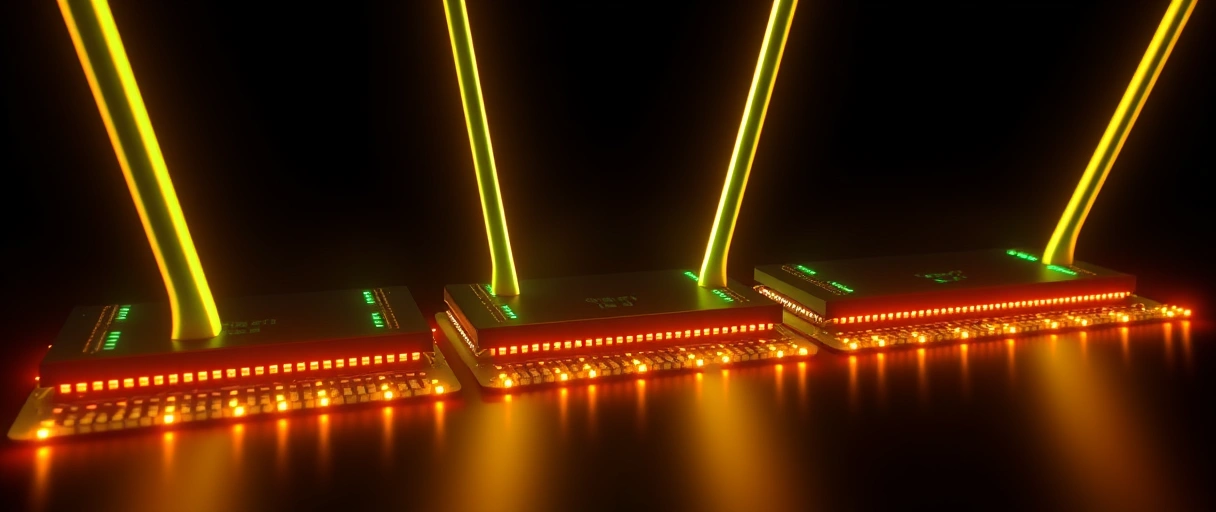
Ray tracing is accelerated by dedicated units – RT cores on NVIDIA, Ray Accelerators on AMD – that compute ray-geometry intersections far faster than general shaders:

- NVIDIA RT cores: fixed-function hardware (now 4th generation) that traverses the BVH and tests intersections, freeing the shader cores for other work.
- AMD Ray Accelerators: the RDNA equivalent; RDNA 4 doubled RT throughput over RDNA 3, making Radeon genuinely competitive for the first time.
- Intel Arc: includes ray tracing units in its Xe architecture; all three are reached through DirectX Raytracing (DXR) and Vulkan ray tracing APIs.
- Generation matters: each new architecture raises throughput, so RT capability is a major factor when picking the best graphics card for gaming.
Without this acceleration, ray intersections on general shaders would be far too slow for real-time frame rates. Best for: judging a card’s ray-tracing readiness by its hardware generation, not just its name.
What Is the Performance Cost of Ray Tracing?
The performance cost is a frame-rate reduction commonly between 30 and 60 percent at high settings, because tracing rays and computing their intersections demands significant extra GPU work:
- Why: enabling RT reflections, shadows, and global illumination adds millions of ray calculations per frame on top of the rasterized base image.
- What scales it: the number of effects enabled, their quality, the resolution (4K hurts most), and the strength of the RT hardware.
- Reality check: even an RTX 5090 averages around 30 fps in Cyberpunk 2077 with full path tracing at native 4K – playable frame rates there depend on upscaling and frame generation.
How Do Upscaling and Frame Generation Offset the Cost?
Upscaling and frame generation offset the cost because upscaling renders at a lower internal resolution and reconstructs it, while frame generation inserts AI-interpolated frames to raise the displayed frame rate:
- Upscaling: NVIDIA DLSS, AMD FSR, and Intel XeSS render internally lower (e.g. 1440p for a 4K target) then reconstruct a sharp full-resolution image, recovering most of the lost frame rate at a small quality cost.
- Frame generation: synthesizes brand-new frames between rendered ones to raise displayed fps – DLSS 4 added AI Multi Frame Generation on RTX 50-series; it adds some latency.
- Ray Reconstruction: an AI denoiser that replaces hand-tuned denoisers for the noisy, under-sampled parts of a ray-traced frame, sharpening reflections and shadows.
- The standard pairing: RT plus upscaling is now expected in supporting games; the NVIDIA and AMD approaches differ in upscaling image quality and RT throughput.
Together these make ray tracing playable at high resolutions: a card that loses half its frame rate to RT can recover most of it. Best for: running ray tracing or path tracing at 4K without dropping to a slideshow.
What Is Path Tracing?
Path tracing is the advanced form of ray tracing that simulates the full propagation of light, tracing many bounces per ray to compute complete global illumination:
- Full simulation: instead of adding traced effects onto a rasterized image, it models a scene’s entire lighting by following rays through multiple bounces between surfaces and lights.
- Unified result: reflections, shadows, and indirect lighting are computed together for the most physically accurate image – the same method film uses.
- Very heavy: the cost is far higher than selective ray tracing, so real-time path tracing leans hard on upscaling, frame generation, and flagship hardware (often labeled ‘full ray tracing’ in games).
Path tracing is the direction real-time rendering is moving as RT hardware grows more powerful each generation. Best for: the highest-fidelity mode on top-tier cards, with DLSS or FSR doing the heavy lifting.
Which Games and Hardware Support Ray Tracing?
Ray tracing is supported by a wide range of current games and by every recent GPU generation from NVIDIA, AMD, and Intel:
- Hardware: NVIDIA RTX 20-series onward, AMD Radeon RX 6000-series and later, and Intel Arc all include ray tracing acceleration.
- APIs: exposed through DirectX Raytracing (DXR) and Vulkan ray tracing, so support is engine-wide rather than vendor-locked.
- Software: many major titles offer ray-traced reflections, shadows, and global illumination; some add full path tracing as a high-end option.
- Scaling: performance tracks the card’s RT hardware, so a flagship runs more effects at higher frame rates than an entry card.
A player wanting ray tracing should confirm both that the game supports it and that the card can run it at the target resolution. Best for: matching a specific game’s RT options to the card you actually own.
Rasterization Versus Ray Tracing
The table compares rasterization and ray tracing by method, lighting accuracy, performance cost, and typical use in current games:
| Aspect | Rasterization | Ray Tracing |
|---|---|---|
| Method | Projects triangles to pixels, approximates lighting | Traces light-ray paths, computes lighting directly |
| Reflections | Screen-space only, misses off-screen objects | Accurate, includes off-screen objects |
| Shadows | Shadow maps, approximate softness | Physically correct softness and contact |
| Global illumination | Not computed directly | Indirect light bouncing between surfaces |
| Performance cost | Low, the real-time baseline | High, 30 to 60 percent frame rate reduction |
| Typical use | Base image in all games | Added effects on top of rasterization |
Last Thoughts on Ray Tracing
Ray tracing brings physically accurate lighting to real-time rendering by tracing the paths of light rays rather than approximating them the way rasterization does. It improves reflections, shadows, global illumination, and ambient occlusion by computing light from the true geometry of the scene, including off-screen elements, and it depends on a BVH plus dedicated hardware – RT cores on NVIDIA, Ray Accelerators on AMD – to run within a frame’s time budget.
The trade-off is a 30-60% frame-rate cost that upscaling (DLSS 4, FSR 4, XeSS) and frame generation recover, and path tracing extends the method to full light propagation for the most accurate result. As the hardware strengthens each generation, ray tracing is shifting from an optional effect toward the standard lighting model.
Key Takeaways:
- Ray tracing casts rays from the camera, finds hits via a BVH, and spawns secondary rays to compute accurate reflections, shadows, and global illumination.
- Rasterization projects geometry and fakes lighting, so games run a hybrid – raster base image plus selective ray-traced effects.
- RT cores (NVIDIA, 4th gen) and Ray Accelerators (AMD; RDNA 4 doubled RT) traverse the BVH and test intersections in dedicated hardware.
- The performance cost is commonly a 30-60% frame-rate drop; an RTX 5090 averages ~30 fps in Cyberpunk path tracing at native 4K.
- Upscaling (DLSS 4, FSR 4, XeSS) and frame generation recover most of the lost frame rate; Ray Reconstruction denoises traced lighting.
- Path tracing is the full-simulation form that traces many bounces per ray, demanding the most capable hardware and upscaling.
Frequently Asked Questions (FAQs)
What is ray tracing in simple terms?
Ray tracing is a rendering technique that simulates the paths of light rays to produce accurate reflections, shadows, and lighting. It computes how light actually travels rather than approximating it like rasterization.
What is the difference between ray tracing and rasterization?
Rasterization projects geometry to pixels and approximates lighting quickly. Ray tracing traces actual light-ray paths for accurate reflections and shadows, including off-screen objects, at a higher performance cost.
Does ray tracing lower frame rates?
Yes. Ray tracing commonly reduces frame rates by 30 to 60 percent at high settings. Upscaling such as DLSS, FSR, or XeSS and frame generation recover much of that lost frame rate.
What hardware is needed for ray tracing?
Ray tracing needs dedicated acceleration: RT cores on Nvidia cards, Ray Accelerators on AMD cards, and ray tracing units on Intel Arc. These compute ray-geometry intersections far faster than general shaders.
What is path tracing?
Path tracing is the advanced form of ray tracing that simulates full light propagation through many bounces, computing complete global illumination. It is the most accurate and most demanding rendering method.
Is ray tracing worth turning on?
Ray tracing improves lighting accuracy at a frame rate cost. With capable hardware and upscaling enabled, it is playable at high resolutions. On entry cards, the performance cost may outweigh the visual gain.
About the author

Nizam Ud DeenFounder and Tech Blogger
Muhammad Nizam Ud Deen Usman is the founder of theCoreiTech and the author of The Local SEO Cosmos. He has worked in search since 2014 as an SEO consultant for eCommerce stores and local businesses, specialising in eCommerce SEO, local SEO and technical SEO, and runs SEO Academy and the SEO Community from Multan, Pakistan. He also founded ORM Digital Solutions, a digital agency serving medium and large businesses, and holds a degree from the University of Education, Lahore (Multan Campus). Plerdy lists him among its Best 20+ SEO Experts in Pakistan. Nizam started theCoreiTech in 2012 to make computers easier to understand and use for everyone. More of his work is at nizamuddeen.com.
